
Scientists Discover Evidence of Cannabis Use 2,800 Years Ago
Key Takeaways
- Cannabis use dates back at least 2,800 years: New archaeological findings suggest people may have been consuming cannabis for its psychoactive effects nearly three millennia ago.
- Researchers discovered more than 1,000 cannabis seeds: They found the seeds inside an ancient Scythian burial mound in southern Siberia.
- Scientists found cannabinoid signals in human hair: Chemical analysis revealed traces consistent with THC and CBN in remarkably well-preserved human remains.
- Cannabis may have played a role in ancient rituals: The discovery suggests the plant could have been associated with ceremonial or spiritual practices.
- The evidence is promising but not conclusive: Scientists are still debating whether the cannabinoid signals prove consumption or could have resulted from external contamination.
Cannabis culture might be much older than we thought.
An international team of archaeologists has uncovered evidence suggesting that humans were consuming cannabis for its psychoactive effects as far back as 2,800 years ago. The discovery, published in the prestigious scientific journal Science on November 5, 2026, comes from an ancient burial site in southern Siberia.
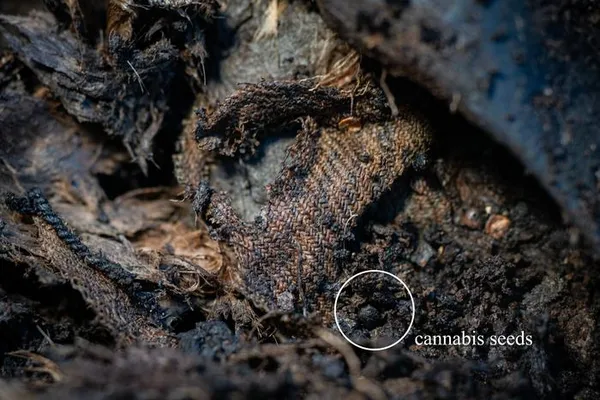
Researchers discovered more than 1,000 cannabis seeds alongside remarkably well-preserved human hair containing chemical signals associated with cannabinoids, including THC and CBN.
The findings could represent the earliest directly dated archaeological evidence of humans using cannabis to experience its intoxicating effects.
And the circumstances surrounding the discovery are just as fascinating as the cannabis itself.
Ancient Cannabis Discovered in a 2,800-Year-Old Tomb
Researchers made the discovery at Tunnug 1, a massive burial mound in the Uyuk Valley of southern Siberia, in what is now the Russian Republic of Tuva.
The site belongs to the Scythians, an ancient group of nomadic peoples known for their horseback riding, elaborate burial traditions, and sophisticated craftsmanship.
Archaeologists have been excavating the burial mound since 2017, uncovering weapons, horse equipment, human remains, and other artifacts associated with the Scythian elite.
Among these discoveries were more than 1,000 tiny cannabis seeds.
Using radiocarbon dating, researchers established that the seeds originated in the early eighth century BCE, approximately 2,800 years ago.
Their presence in the burial chamber suggests that cannabis may have held cultural or ceremonial importance.
However, cannabis seeds alone cannot prove that ancient people were getting high. The plant has been used for thousands of years to produce fiber, food, and oil.
The researchers needed something more convincing.
Fortunately, they found it in an unexpected place: human hair.
Scientists Found Evidence of Cannabis in Human Hair
The cold Siberian environment had preserved human hair inside the burial chamber for nearly three millennia.
Researchers analyzed the samples using sophisticated chemical techniques, including high-resolution mass spectrometry.
They identified chemical signals consistent with cannabinol (CBN), a compound that can form when THC breaks down through oxidation.
They also detected weaker signals consistent with THC itself.
This was particularly significant because the researchers were no longer dealing exclusively with cannabis plants found near human remains. They had chemical evidence from the remains themselves.
The combination of ancient cannabis seeds and cannabinoid-related signals in human hair led the researchers to propose that cannabis had been consumed for its psychoactive effects.
If confirmed, it would provide an extraordinary glimpse into the relationship between humans and cannabis nearly 3,000 years ago.
Were Ancient People Smoking Weed?
That’s the million-dollar question.
Although the findings suggest that ancient people were exposed to cannabis, researchers cannot determine exactly how they used it.
They may have inhaled cannabis smoke during rituals, consumed cannabis preparations, or encountered the plant through another form of exposure.
The chemical analysis cannot establish how much cannabis was used or whether the individuals experienced a noticeable high.
There is also no evidence that these ancient communities smoked joints or used anything resembling modern bongs.
What researchers do know is that cannabis smoking has historical roots in Central Asia.
At other archaeological sites, scientists have discovered cannabinoid residues on heated stones and inside wooden braziers, suggesting that cannabis was burned and its smoke inhaled during ceremonial gatherings.
The latest Siberian discovery could push the history of psychoactive cannabis use even further into the past.
Cannabis May Have Played a Role in Sacred Rituals
One of the most intriguing aspects of the discovery is where the cannabis was found.
Tunnug 1 was not an ordinary burial site.
It was a monumental tomb associated with high-ranking members of Scythian society. Excavations have revealed evidence of extensive horse sacrifices and possible human sacrifices connected to elaborate funeral ceremonies.
Researchers believe cannabis may have played a role in these rituals.
One possibility is that the plant was used to induce altered states of consciousness during religious or ceremonial activities.
Cannabis might also have been burned as part of funeral practices, although the precise purpose remains unknown.
These interpretations are consistent with later historical accounts of Scythian cannabis use.
The ancient Greek historian Herodotus described Scythians using heated stones and cannabis in enclosed spaces during purification rituals in the fifth century BCE.
The new findings suggest that cannabis-related traditions in the region may have existed centuries before those accounts were written.
The Discovery Pushes Cannabis History Back 300 Years
Humans have cultivated and used cannabis for thousands of years, but identifying when people first began using it specifically to get high has always been difficult.
Cannabis leaves, flowers, and resins rarely survive in archaeological sites.
Even when scientists find seeds, they cannot automatically conclude the plant was consumed for its intoxicating effects.
Before this discovery, some of the strongest archaeological evidence for psychoactive cannabis use came from approximately 2,500-year-old burial sites in western China.
Researchers had identified cannabinoid residues in wooden braziers, indicating that cannabis was likely burned during funeral ceremonies.
The new Siberian findings suggest psychoactive cannabis use may date back another 300 years.
Importantly, that does not mean humans first discovered cannabis 2,800 years ago.
The plant was already being used for other purposes long before then.
It simply means scientists may now have evidence of its intoxicating use from an earlier period than previously documented.
How Strong Is the Scientific Evidence?
While the discovery is exciting, not every scientist agrees that the evidence conclusively demonstrates cannabis consumption.
The researchers identified signals consistent with cannabinoids in ancient human hair, but an independent forensic toxicologist has questioned whether those substances necessarily entered the body through consumption.
Because cannabis seeds were also present in the burial environment, external contamination remains a possible explanation.
Volker Auwärter, a forensic toxicologist at the University Medical Center in Freiburg, Germany, argued that additional testing would have helped distinguish actual consumption from environmental exposure.
Other researchers have defended the approach, noting that chemical analysis of ancient hair is an established technique for investigating historical drug exposure.
The findings therefore provide an important new piece of evidence, but they do not settle every question about how cannabis was used.
The distinction matters: discovering cannabinoids in ancient remains is not automatically the same as proving that someone intentionally got high.
What Comes Next?
The research team is already investigating the ancient cannabis samples further.
According to the University of Bern in Switzerland, researchers have begun sequencing DNA from the preserved plant material.
Because the samples are exceptionally well preserved, the genetic information could provide new insights into the domestication, evolution, and geographical spread of cannabis.
Future analysis might help scientists understand whether ancient communities cultivated particular cannabis varieties and how the plant eventually became such an important part of human culture.
For now, the discovery offers a fascinating reminder that the relationship between humans and cannabis stretches back far beyond modern dispensaries, legalization debates, and recreational smoking.
Nearly 3,000 years ago, cannabis may already have been part of deeply meaningful cultural and spiritual traditions.
As archaeology continues to uncover evidence from the ancient world, its history could be even older than we imagine.