CBD for Pets: Benefits, Risks, Dosage & What Research Says
Key Takeaways
- CBD is a non-intoxicating cannabinoid that may help support pain management, mobility, anxiety, and seizure control in some pets.
- Unlike THC, CBD does not produce a high and is generally considered safer for dogs and cats.
- The strongest veterinary research currently exists for osteoarthritis and epilepsy in dogs.
- Pets have an endocannabinoid system, which helps explain why cannabinoids may influence pain, inflammation, mood, appetite, and neurological function.
- Product quality matters. Pet owners should compare CBD strength, extract type, customer reviews, testing standards, and price per milligram.
- There is no universal dosage that works for every animal. Start low, increase gradually, and consult a veterinarian whenever possible.
Millions of pet owners now use CBD oils, treats, and supplements for their dogs and cats, often hoping to ease pain, reduce anxiety, improve mobility, or support overall well-being. Walk into a pet store today, and you’ll likely find an entire shelf dedicated to hemp-derived products marketed specifically for animals.
But does CBD actually work, or is it simply another wellness trend?
The truth lies somewhere in the middle. CBD is not a miracle cure, and many marketing claims still outpace the science. At the same time, veterinary researchers have produced promising results in several areas, particularly osteoarthritis and epilepsy in dogs. These studies suggest that cannabinoids may offer meaningful benefits for some animals when used responsibly and alongside proper veterinary care.
Understanding what CBD is, how it works, and what research has actually shown can help pet owners separate evidence from hype.
What Is CBD?
CBD, short for cannabidiol, is one of more than one hundred naturally occurring cannabinoids found in cannabis plants. Unlike THC, the compound responsible for the intoxicating effects of cannabis, CBD does not produce a high.
Most pet CBD products are derived from hemp, a variety of cannabis that naturally contains very low levels of THC. The cannabinoid is extracted from the plant and then incorporated into oils, treats, capsules, chews, and other products designed specifically for animals.
Researchers became interested in CBD because it interacts with biological systems involved in pain perception, inflammation, mood regulation, appetite, sleep, and neurological function. While scientists are still learning exactly how these interactions occur, early findings have been promising enough to spark significant interest in both human and veterinary medicine.
Why Are So Many Pet Owners Using CBD?
Part of CBD’s popularity stems from changing attitudes toward cannabis and hemp-derived products. As research on cannabinoids expanded, many pet owners began wondering whether some of the same compounds that appeared promising for humans could also help animals.
Another factor is the aging pet population. Dogs and cats are living longer than ever before, which means more owners are managing age-related issues such as arthritis, stiffness, reduced mobility, anxiety, and chronic discomfort.
For some pet owners, CBD represents a potentially gentler option that may complement traditional treatments. Others are simply looking for additional tools to help support their pet’s quality of life.
Regardless of motivation, the growing popularity of CBD has created an important need for accurate information and realistic expectations.
CBD vs THC: Why the Difference Matters for Pets
One of the most important things pet owners need to understand is that CBD and THC are not the same compound.
CBD (cannabidiol) is non-intoxicating and is generally considered the safer cannabinoid for pets. THC (tetrahydrocannabinol), on the other hand, is the primary psychoactive compound in cannabis and can cause serious problems in dogs and cats when consumed in excessive amounts.
This distinction is particularly important because dogs appear to be far more sensitive to THC than humans. Scientists believe this may be due to differences in how cannabinoids interact with receptors in the canine brain and nervous system.
When people talk about cannabis helping pets, they are usually referring to CBD-rich hemp products rather than traditional cannabis products that contain significant amounts of THC.
Symptoms of THC toxicity in pets can include:
- Loss of coordination
- Excessive drooling
- Vomiting
- Extreme lethargy
- Tremors
- Agitation
- Urinary incontinence
- Abnormal heart rate
While most pets recover with proper veterinary care, THC exposure can be a frightening and potentially dangerous experience.
For this reason, pet owners should avoid giving animals recreational cannabis products or homemade cannabis edibles. Products designed specifically for pets should clearly state their CBD content and provide lab reports showing THC levels.
CBD Isolate vs Broad-Spectrum vs Full-Spectrum CBD
Not all CBD products are created equal. Understanding the different types of hemp extracts can help pet owners make more informed decisions when shopping for CBD oils, treats, or supplements.
CBD isolate is the purest form of CBD available. During extraction, all other cannabinoids, terpenes, and plant compounds are removed, leaving only cannabidiol behind.
Some owners prefer CBD isolate because it contains no THC and allows for very precise dosing. However, others believe it may not provide the same level of benefits as more complete hemp extracts.
Broad-spectrum CBD sits somewhere in the middle. These products contain CBD along with additional cannabinoids and terpenes naturally found in hemp, but THC is typically removed during processing.
Many pet owners view broad-spectrum products as a good compromise because they provide a wider range of plant compounds while minimizing concerns about THC exposure.
Full-spectrum CBD contains CBD along with the widest range of naturally occurring cannabinoids and terpenes. These products may also contain trace amounts of THC within legal limits.
Supporters of full-spectrum extracts often point to the entourage effect, the theory that cannabinoids and terpenes work better together than in isolation. Some researchers believe these compounds may produce complementary effects when consumed as part of a complete plant extract.
However, because pets can be sensitive to THC, owners should exercise extra caution when choosing full-spectrum products. If a product contains THC, even in small amounts, that information should be clearly displayed and verified through independent laboratory testing.
How CBD Works in Animals
To understand why CBD may affect pets, it helps to understand the endocannabinoid system.
The endocannabinoid system is a biological network found throughout the bodies of mammals, including dogs, cats, horses, and humans. Its role is to help maintain balance across numerous physiological processes.
Researchers have discovered that the endocannabinoid system influences functions such as pain perception, inflammation, appetite, mood, sleep, immune response, and neurological activity.
The body naturally produces compounds known as endocannabinoids that interact with cannabinoid receptors located throughout the brain, organs, immune system, and nervous system.
Plant-derived cannabinoids such as CBD do not behave exactly like the body’s own endocannabinoids, but they appear to influence many of the same systems.
Scientists are still working to fully understand these interactions. What they do know is that the endocannabinoid system helps explain why cannabinoids can affect such a wide range of biological functions.
This is also one reason researchers became interested in studying CBD for conditions such as chronic pain, epilepsy, anxiety, and inflammation.
Without an endocannabinoid system, the idea of using cannabinoids for health purposes would make far less sense. The existence of this system provides a biological foundation for the growing field of cannabinoid research.
CBD for Pain & Arthritis
If there is one area where CBD for pets has generated the most excitement among researchers, it is pain management.
As dogs age, osteoarthritis becomes increasingly common. This degenerative joint condition can lead to chronic pain, stiffness, reduced mobility, and a lower quality of life.
Many owners first notice arthritis when their dog becomes reluctant to climb stairs, struggles to stand up after resting, moves more slowly during walks, or loses interest in activities they once enjoyed.
Several veterinary studies have investigated whether CBD may help address these symptoms.
One of the most frequently cited studies comes from researchers associated with Cornell University. In the study, dogs with osteoarthritis received CBD oil twice daily. Researchers observed significant improvements in comfort and activity levels compared to placebo-treated dogs.
While the study was relatively small, the findings attracted considerable attention, suggesting that CBD may provide measurable benefits for dogs with chronic joint discomfort.
This does not mean CBD cures arthritis. Arthritis remains a progressive condition that requires ongoing management. However, some veterinarians and pet owners view CBD as a potentially useful tool within a broader treatment plan that may also include weight management, physical therapy, joint supplements, prescription medications, and lifestyle modifications.
For aging dogs, even modest improvements in comfort and mobility can have a meaningful impact on daily life.
CBD for Anxiety & Stress
Another common reason pet owners explore CBD is anxiety.
Dogs and cats can experience stress for many of the same reasons humans do. Loud noises, unfamiliar environments, travel, separation from family members, grooming appointments, and veterinary visits can all trigger anxiety-related behaviors.
Fireworks and thunderstorms are among the most frequently cited examples. Some dogs become visibly distressed during these events, pacing, trembling, hiding, barking excessively, or attempting to escape. Some pet owners use CBD to help support calm behavior during stressful events such as fireworks, thunderstorms, travel, or veterinary visits. While some dogs appear to respond within a few hours of receiving CBD, many owners prefer to start several days before an anticipated stressful event. This allows time to observe the pet’s response, adjust the dosage if necessary, and establish a consistent routine before the event itself.
Many owners report that CBD helps their pets remain calmer during stressful situations. However, the scientific evidence supporting CBD for anxiety is currently less developed than the evidence for arthritis or epilepsy.
That does not necessarily mean CBD is ineffective. Rather, it means researchers need larger and more rigorous studies before drawing strong conclusions.
Anxiety is also highly individual. What works for one dog may not work for another. In many cases, successful anxiety management involves a combination of behavioral training, environmental adjustments, routine, enrichment activities, and veterinary guidance.
CBD may eventually prove to be a useful addition to that toolkit, but current evidence remains preliminary.
CBD for Seizures & Epilepsy
One of the most promising areas of veterinary CBD research involves epilepsy.
Seizures are among the most difficult conditions for pet owners to manage. While many dogs respond well to traditional anti-seizure medications, others continue to experience breakthrough seizures despite treatment. This has led researchers to investigate whether CBD may provide additional support.
One of the best-known studies in this area came from Colorado State University, where researchers examined CBD as an add-on treatment for dogs with epilepsy. The results showed that dogs receiving CBD experienced a greater reduction in seizure frequency than those receiving a placebo. While CBD did not eliminate seizures entirely, the findings suggested that it may help some dogs achieve better seizure control when combined with conventional medication.
This mirrors what researchers have observed in human medicine. In recent years, CBD-based medications have been approved for certain rare forms of epilepsy after demonstrating meaningful benefits in clinical trials.
It is important to understand that CBD should never replace prescribed anti-seizure medications without veterinary supervision. Epilepsy can be a serious and potentially life-threatening condition. However, the existing research suggests that CBD may become an increasingly valuable tool for veterinarians managing difficult seizure cases.
Of all the conditions discussed in this article, epilepsy and osteoarthritis currently have some of the strongest scientific support behind them.
CBD for Senior Pets
Older pets often face multiple challenges at the same time.
An aging dog may be dealing with arthritis, reduced mobility, anxiety, sleep disturbances, chronic inflammation, and slower recovery from exercise or injury. Likewise, senior cats can become less active, develop joint problems, and experience behavioral changes as they age.
Because CBD appears to influence several biological systems simultaneously, many owners turn to it as a general wellness supplement for older animals.
The goal is usually not to treat a specific disease. Instead, owners hope to improve overall comfort and quality of life.
Some pet owners report that their senior dogs appear more active, move more comfortably, or seem more relaxed after introducing CBD into their daily routine. While these observations are largely anecdotal, they align with some of the areas researchers are currently studying.
Aging itself is not a disease, and CBD is not a fountain of youth. However, if it helps reduce discomfort, supports mobility, or improves day-to-day well-being, it may play a useful role within a broader senior care plan.
For many pet owners, even small improvements in comfort can make a meaningful difference during a pet’s later years.
CBD for Appetite & General Wellness
Another reason some owners explore CBD is its potential influence on appetite and overall wellness.
Pets recovering from illness, surgery, or periods of stress may occasionally experience reduced appetite. In humans, cannabinoids are well known for their ability to influence hunger and food intake. Researchers are still working to determine exactly how these mechanisms apply to animals and whether CBD alone offers meaningful benefits in this area.
At the moment, the evidence remains limited.
Some owners report improvements in appetite, mood, and general well-being after introducing CBD products. Others notice little difference. Because these effects can be difficult to measure objectively, they remain among the least proven benefits associated with pet CBD.
This does not mean they are impossible. It simply means more research is needed before strong conclusions can be made.
As with many areas of cannabinoid science, the most honest answer is that the evidence is promising but incomplete.
What Does the Research Actually Say?
One of the biggest problems in the CBD industry is that marketing often moves faster than science.
Browse enough websites, and you’ll eventually find claims that CBD can help virtually every health condition imaginable. The reality is far more nuanced.
The strongest veterinary evidence currently exists for two specific areas:
Areas With The Strongest Evidence
- Osteoarthritis and chronic pain in dogs
- Epilepsy and seizure management in dogs
These are the areas where researchers have conducted controlled clinical studies and observed measurable benefits.
Areas With Promising But Limited Evidence
- Anxiety and stress
- Mobility support
- Age-related discomfort
- Inflammation
- General wellness
While many pet owners report positive experiences, researchers still need larger studies to confirm these effects.
Areas Where More Research Is Needed
- Long-term CBD use
- CBD use in cats
- CBD use in horses and other animals
- Interactions with medications
- Specific medical conditions beyond arthritis and epilepsy
The good news is that veterinary cannabinoid research is expanding rapidly. Every year, scientists gain a better understanding of how cannabinoids interact with animal physiology and where CBD may provide meaningful benefits.
The bad news is that we still don’t have all the answers.
Pet owners should approach CBD with realistic expectations. The science is encouraging, but it is still evolving.
Is CBD Safe for Dogs and Cats?
Overall, current research suggests that CBD is generally well tolerated by most dogs and cats when used appropriately.
That does not mean side effects are impossible.
Like any supplement, CBD can affect animals differently depending on factors such as species, age, health status, body weight, dosage, and other medications.
Reported side effects may include:
- Drowsiness
- Digestive upset
- Temporary diarrhea
- Changes in appetite
- Dry mouth
- Mild lethargy
Some studies have also observed temporary changes in liver enzyme levels. While this does not necessarily indicate liver damage, it highlights the importance of discussing CBD use with a veterinarian, especially if a pet is already taking prescription medications.
Cats deserve special consideration because they metabolize substances differently than dogs. While early research suggests CBD may be tolerated by cats, far fewer studies have been conducted.
The biggest safety concern remains THC exposure. Products intended for humans may contain significantly more THC than is appropriate for animals. This is why pet-specific formulations are generally the safest option.
When used responsibly and sourced from reputable manufacturers, CBD appears to have a relatively favorable safety profile. However, owners should always monitor their pets carefully when introducing any new supplement.
How To Choose a Quality CBD Product
The CBD market has exploded over the last decade, and product quality varies dramatically between brands.
Unfortunately, a fancy label does not guarantee a quality product.
Buy From Established Brands
One of the simplest ways to reduce risk is to choose companies with a proven track record.
Look for brands that have:
- Thousands of customer reviews
- Transparent business practices
- Clear product information
- Positive reputation within the industry
A company that has successfully served pet owners for years is generally a safer bet than a brand that appeared last month.
Compare Price Per Milligram
This is one of the most overlooked aspects of buying CBD.
Many consumers focus only on the bottle price, which can be misleading.
For example:
- Product A costs $30 and contains 250mg of CBD
- Product B costs $60 and contains 1,500mg of CBD
At first glance, Product A looks cheaper. In reality, Product B delivers significantly more CBD for the money.
Always compare products based on cost per milligram rather than total bottle price.
Understand The Extract Type
Before purchasing, determine whether the product uses:
- CBD isolate
- Broad-spectrum CBD
- Full-spectrum CBD
Each has advantages and disadvantages, and understanding the difference can help you choose the option that best fits your pet’s needs.
Verify Third-Party Lab Testing
Reputable manufacturers provide independent laboratory reports, often called Certificates of Analysis (COAs).
These reports help verify:
- CBD content
- THC levels
- Product purity
- Absence of contaminants
- Check THC Content
For pets, low THC content is critical.
Even if a product is labeled “full-spectrum,” the THC level should be clearly disclosed and supported by laboratory testing.
CBD Dosage Guide for Pets
One of the most common questions pet owners ask is how much CBD they should give their dog or cat. Unfortunately, there is no universal answer.
Unlike many prescription medications, CBD dosing has not yet been standardized across species, conditions, and product types. Factors such as body weight, age, metabolism, overall health, and the specific reason for using CBD can all influence how much may be appropriate.
This is one reason veterinarians often recommend a conservative approach.
Rather than starting with a large amount, most experts suggest beginning with a low dose and gradually increasing it while monitoring your pet’s response.
A commonly cited starting range is approximately 0.2 to 0.5 mg of CBD per pound of body weight once or twice daily. However, this should be viewed as a general guideline rather than a strict rule.
General Starting Guide
Pet Weight Suggested Starting Daily CBD Range
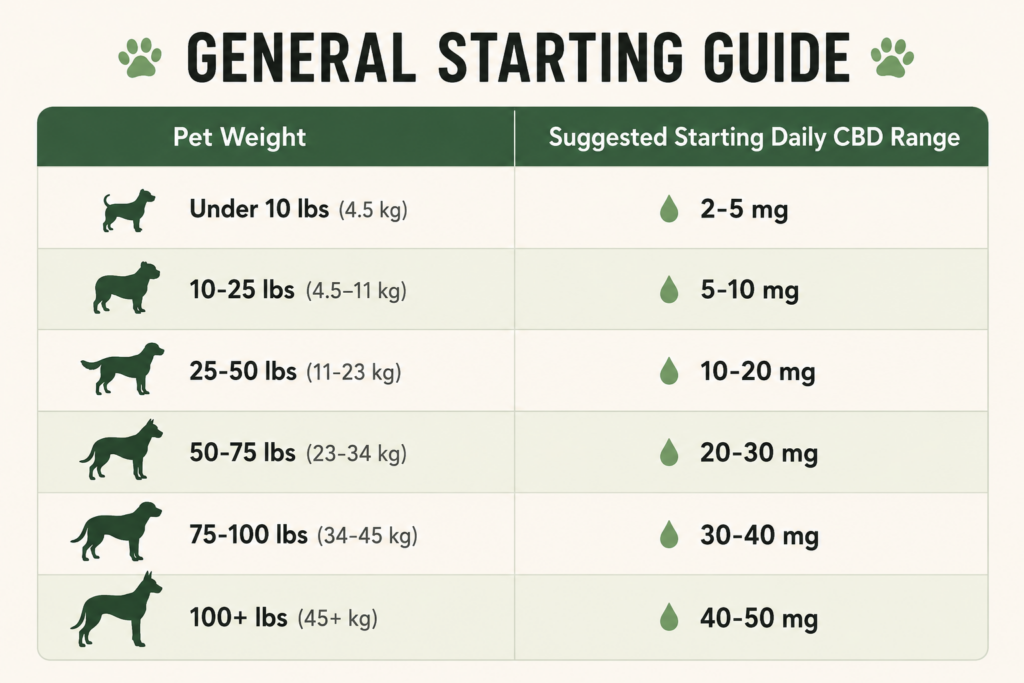
These figures should be viewed as conservative starting points rather than optimal doses.
Some pets respond well to very small amounts, while others may require higher doses under veterinary supervision.
Start Low and Observe
When introducing CBD, it is often helpful to keep notes on your pet’s behavior, mobility, appetite, sleep patterns, and overall comfort.
Many owners notice changes within a few hours, while others report that improvements become more apparent after several days or weeks of consistent use.
Patience is important. CBD is not like a painkiller that necessarily produces immediate results. Some potential benefits may develop gradually over time.
When To Speak With Your Veterinarian
Veterinary guidance becomes especially important if your pet:
- Takes prescription medications
- Suffers from epilepsy
- Has liver disease
- Has a chronic medical condition
- Is pregnant or nursing
- Experiences unusual side effects
CBD may interact with certain medications, making professional advice particularly valuable for animals with existing health concerns.
Conclusion
CBD has quickly become one of the most popular wellness supplements for pets, and for good reason. While much remains to be learned, the current research suggests that cannabinoids may offer meaningful benefits for some animals, particularly in areas such as osteoarthritis, chronic pain, mobility support, and seizure management.
At the same time, it is important to separate scientific evidence from marketing claims. CBD is not a miracle cure, and it will not solve every health problem. Some of the strongest evidence currently exists for arthritis and epilepsy in dogs, while many other potential applications remain under investigation.
For pet owners interested in trying CBD, education is the best starting point. Understanding how cannabinoids work, recognizing the difference between CBD and THC, choosing reputable products, and maintaining realistic expectations can go a long way toward ensuring a safe and positive experience.
The quality of the product matters just as much as the cannabinoid itself. Established brands, transparent testing, verified customer reviews, and clearly labeled CBD content are often the best indicators of a trustworthy product.
As research into cannabinoids continues to grow, scientists will gain a clearer understanding of where CBD truly shines and where its limitations lie. For now, the evidence suggests that CBD may be a valuable addition to the pet wellness toolbox when used responsibly and in consultation with a veterinarian.
Whether you are caring for an aging dog struggling with arthritis, a pet dealing with anxiety, or simply exploring ways to support long-term wellness, CBD is a topic worth understanding. The science is still evolving, but the conversation around cannabinoids and animal health is only just beginning.
Sources & Studies
Cornell University Osteoarthritis Study
Gamble LJ, Boesch JM, Frye CW et al. Pharmacokinetics, Safety, and Clinical Efficacy of Cannabidiol Treatment in Osteoarthritic Dogs.
Colorado State University Epilepsy Study
McGrath S, Bartner LR, Rao S et al. Randomized, blinded, controlled clinical trial assessing the effect of oral cannabidiol administration in addition to conventional antiepileptic treatment on seizure frequency in dogs with intractable idiopathic epilepsy.
CBD Safety Study in Dogs and Cats
Vaughn D, Kulpa J, Paulionis L. Preliminary investigation of the safety of escalating cannabinoid doses in healthy dogs and cats.