Flock Cameras Tracked Man Across State Lines Before Police Searched His Car for Cannabis
Key Takeaways
- Wisconsin police used Flock cameras to examine a man’s travel history between Wisconsin and Michigan.
- Court records referenced his frequent trips to Michigan, which authorities characterized as a source state for cannabis because recreational cannabis is legal there.
- The man also had an outstanding felony warrant, an important detail surrounding the initial police stop.
- Police later reported smelling cannabis and ultimately discovered cannabis and related items inside the vehicle.
- The case has raised broader concerns about using Flock cameras to analyze people’s movements across cities and state lines.
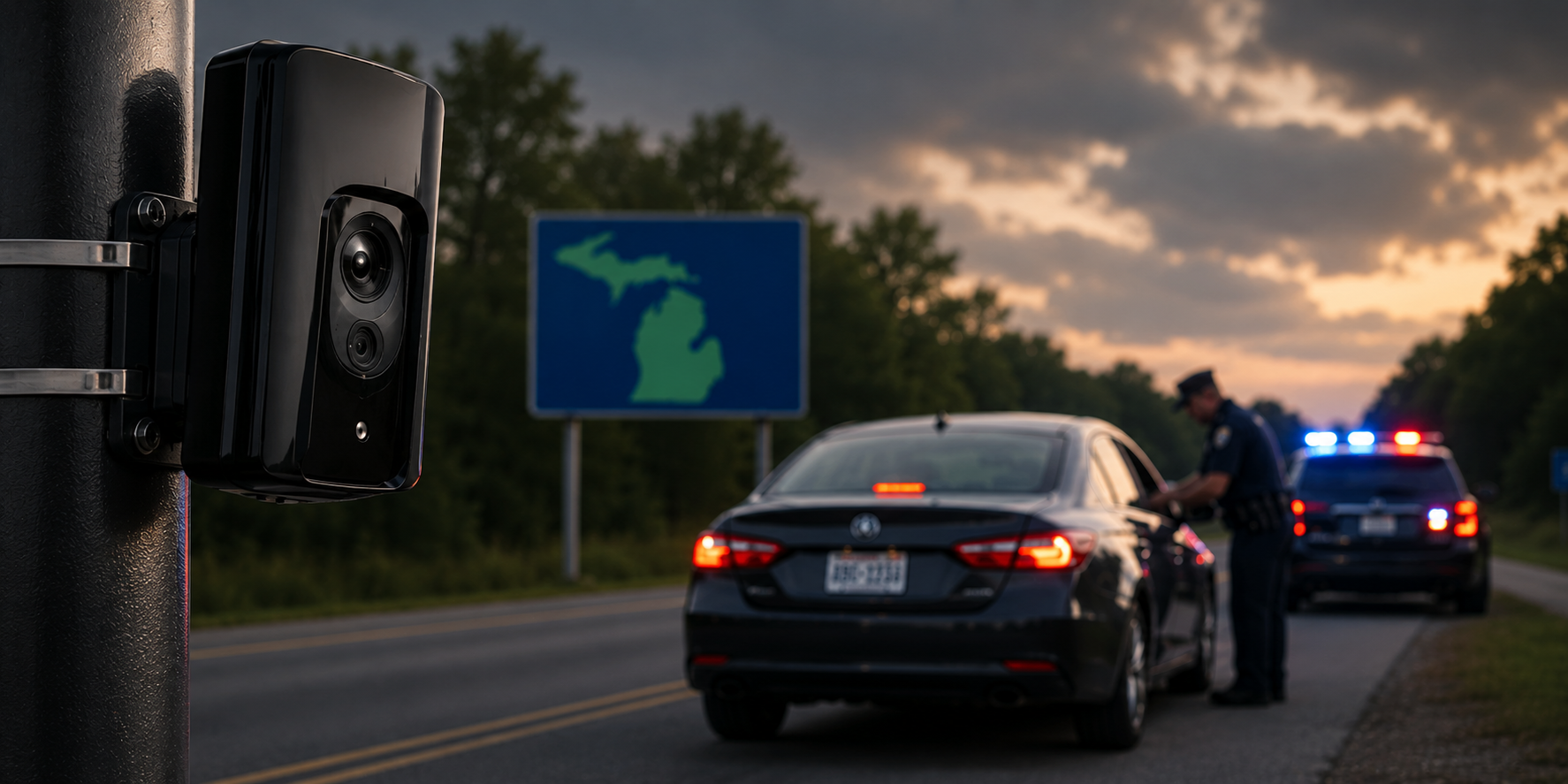
Wisconsin police used Flock cameras to track a man’s repeated trips across state lines to Michigan, where recreational cannabis is legal, before stopping and searching his vehicle.
The case occurred in April 2025 but attracted national attention in August 2026 after 404 Media reported on court records detailing how Flock data was used during the investigation. Investigators examined the man’s travel history and specifically referenced his frequent trips to Michigan when discussing suspected cannabis activity.
The story has since spread rapidly across social media, adding to a growing debate over Flock cameras, cannabis enforcement and how much information police should be able to collect about where Americans
How Police Used Flock Cameras to Track His Trips
The case centers on Edward Abrams-Phillips and an incident that occurred on April 26, 2025, in Brown County, Wisconsin.
According to reporting based on the criminal complaint, a sheriff’s deputy received a Flock alert identifying a vehicle registered to Abrams-Phillips. He reportedly had an outstanding felony warrant connected to a domestic violence case.
Investigators, however, had access to more than the vehicle’s location at that particular moment.
Flock data allowed authorities to examine previous detections of the vehicle. Those records showed repeated travel between Wisconsin and Michigan.
One of the most controversial details to emerge from the court records was the reference to the vehicle frequently traveling to Michigan, which authorities characterized as a source state for cannabis because recreational cannabis is legal there.
The man’s pattern of traveling to a state with legal recreational cannabis therefore became part of the investigative picture surrounding suspected cannabis activity.
What Are Flock Cameras?
Flock cameras are roadside surveillance systems developed by Flock Safety that automatically collect information about passing vehicles.
The cameras can capture license plates and other vehicle characteristics and make those observations searchable by participating law enforcement agencies.
This means investigators may be able to do more than determine where a vehicle was spotted at one particular moment. Previous detections can potentially be searched to establish patterns of movement across different locations.
Supporters argue that Flock cameras can help authorities locate stolen vehicles, find missing people and identify vehicles connected to serious crimes.
Privacy advocates are concerned about the same capabilities for a different reason: when large numbers of cameras are connected, they can potentially create a searchable record of where a person’s vehicle has traveled.
Traveling to Michigan Became Part of the Cannabis Investigation
The cannabis element is what has pushed this particular case into the national spotlight.
Michigan legalized recreational cannabis for adults, while Wisconsin continues to prohibit recreational cannabis.
Millions of Americans routinely cross state borders for work, tourism, shopping, family visits and countless other legitimate reasons. Simply traveling to Michigan does not establish that someone visited a dispensary, purchased cannabis or transported cannabis back into Wisconsin.
Yet Abrams-Phillips’ repeated Michigan trips were specifically referenced as authorities investigated suspected cannabis activity.
That raises a larger question: Should frequent travel to a state where cannabis is legal become a factor in a drug investigation?
The issue could become increasingly important as more states legalize cannabis while neighboring states maintain prohibition.
Police Ultimately Found Cannabis in the Vehicle
There is an important distinction between the viral version of the story and the full circumstances surrounding the stop.
Police did not simply identify someone traveling to Michigan and search his vehicle solely because he had visited a legal cannabis state.
Abrams-Phillips reportedly had an outstanding felony warrant when authorities stopped him. An officer also reported smelling raw cannabis coming from the vehicle.
Police subsequently searched the vehicle and reportedly discovered approximately a quarter-ounce of cannabis, a grinder and a container containing cannabis residue.
Those details matter when evaluating the eventual vehicle search.
However, they do not eliminate the privacy question raised by what happened beforehand. Police had access to Flock data documenting the man’s interstate movements, and his repeated travel to Michigan became relevant to their investigation.
Cannabis Laws Change at the Wisconsin-Michigan Border
The case highlights one of the complications created by America’s patchwork of cannabis laws.
Adults can legally purchase and possess cannabis in Michigan, subject to state regulations.
Crossing into Wisconsin with that cannabis is another matter. Recreational cannabis remains illegal under Wisconsin law.
That means conduct permitted on one side of the state border can potentially result in criminal consequences on the other.
Flock cameras introduce a new dimension to that divide.
Police no longer necessarily need to personally observe someone repeatedly crossing a state border. A network of cameras can potentially identify travel patterns and make those records searchable afterward.
Flock Cameras Face Growing Privacy Concerns
The Wisconsin case arrives amid broader scrutiny of Flock cameras across the United States.
The central questions concern how much information should be collected, how long it should be retained, which agencies should have access and what level of suspicion should be required before police can search someone’s historical movements.
The concern is not necessarily about whether Flock cameras can serve legitimate law enforcement purposes.
A system capable of quickly locating a kidnapping suspect, stolen vehicle or dangerous fugitive can provide obvious public-safety benefits.
The controversy is over how far that surveillance capability should extend.
The more locations covered by Flock cameras, the easier it becomes to piece together a picture of where a particular vehicle has traveled. Technology initially justified for serious crimes can potentially also be used to investigate much less serious conduct.
Cannabis enforcement is now part of that discussion.
Cannabis Legalization Meets Digital Surveillance
The Wisconsin case ultimately involves something larger than one cannabis possession investigation.
Recreational cannabis is now legal in numerous states while prohibition remains in place elsewhere. Americans routinely travel between those jurisdictions without doing anything illegal.
Flock cameras give law enforcement a powerful new way to analyze those movements.
A trip to Michigan does not reveal why someone traveled there. Even repeated trips do not prove that cannabis was purchased or transported across state lines.
The bigger question is what happens when otherwise legal travel patterns become investigative signals simply because of where someone has been.
As Flock cameras continue to expand across the country, courts, lawmakers and communities will increasingly have to decide where the line should be drawn between legitimate police investigations and mass surveillance.
For cannabis consumers living near state borders, that debate is no longer theoretical.
Should police be allowed to use someone’s travel to a legal cannabis state as part of a drug investigation? Let us know in the comments.