Cannabis in Islam: A Complex and Often Misunderstood History
Today, cannabis is widely considered haram in much of the Muslim world. The modern interpretation is clear: intoxicants are forbidden, and cannabis falls into that category.
Historically, however, the picture was far less straightforward.
For centuries, cannabis existed in a grey zone across Islamic societies. It was used, debated, criticized, and sometimes tolerated, depending on the time, place, and perspective. Rather than being clearly accepted or rejected, cannabis became part of a broader conversation shaped by religion, medicine, culture, and politics.
Understanding this history requires stepping away from modern assumptions and looking at how cannabis was actually treated in the past.
A Plant That Preceded the Debate
Cannabis did not originate within Islamic civilization, but it became part of it early on through trade and cultural exchange. By the medieval period, it was already known and used across regions stretching from Persia to North Africa and South Asia.
It appeared in different forms and under different names, but its presence was consistent. Unlike alcohol, which was explicitly addressed in religious texts, cannabis entered society without a predefined legal framework. That absence would later become central to the debate surrounding it.
By the time urban centers expanded during the Islamic Golden Age, cannabis was already embedded in certain layers of society, particularly among working populations. Its use was visible enough to attract attention, but not uniform enough to generate a single, unified response.
The Religious Question
The core issue that shaped cannabis’s status in Islamic societies was its absence from the Qur’an. While alcohol is clearly prohibited, cannabis is never explicitly mentioned. This forced scholars to interpret whether its effects placed it within the same category.
Some took a strict position, arguing that any substance that alters the mind should be considered forbidden. From this perspective, cannabis naturally fell under the broader principle of banning intoxication.
Others approached the issue with more nuance. Historical descriptions often portrayed cannabis as producing a calmer, more sedative effect compared to alcohol. This led to arguments that it might not qualify as the same kind of intoxicant addressed in scripture.
What emerged was not a consensus, but a long-standing disagreement. Over time, stricter interpretations gained ground, especially as legal schools evolved and sought consistency. Still, the earlier ambiguity never fully disappeared from the historical record.
Society, Status, and Perception
Cannabis use was never just a religious issue. It was also shaped by social dynamics.
In many regions, its use was associated with laborers, artisans, and lower-income groups. This perception influenced how it was judged. Substances associated with the lower classes often faced greater scrutiny, while elite behavior was sometimes treated differently, even when it conflicted with religious norms.
This created a tension that went beyond theology. Restrictions on cannabis were sometimes tied as much to concerns about social order as to religious doctrine. Authorities worried about its effects on productivity and public behavior, and these concerns occasionally translated into attempts at prohibition.
At the same time, enforcement was inconsistent. Cannabis use continued, even in places where it was discouraged or officially banned, suggesting that it had a level of social acceptance that could not be easily erased.
Medicine and Practical Use
While scholars debated its permissibility, physicians approached cannabis from a different angle.
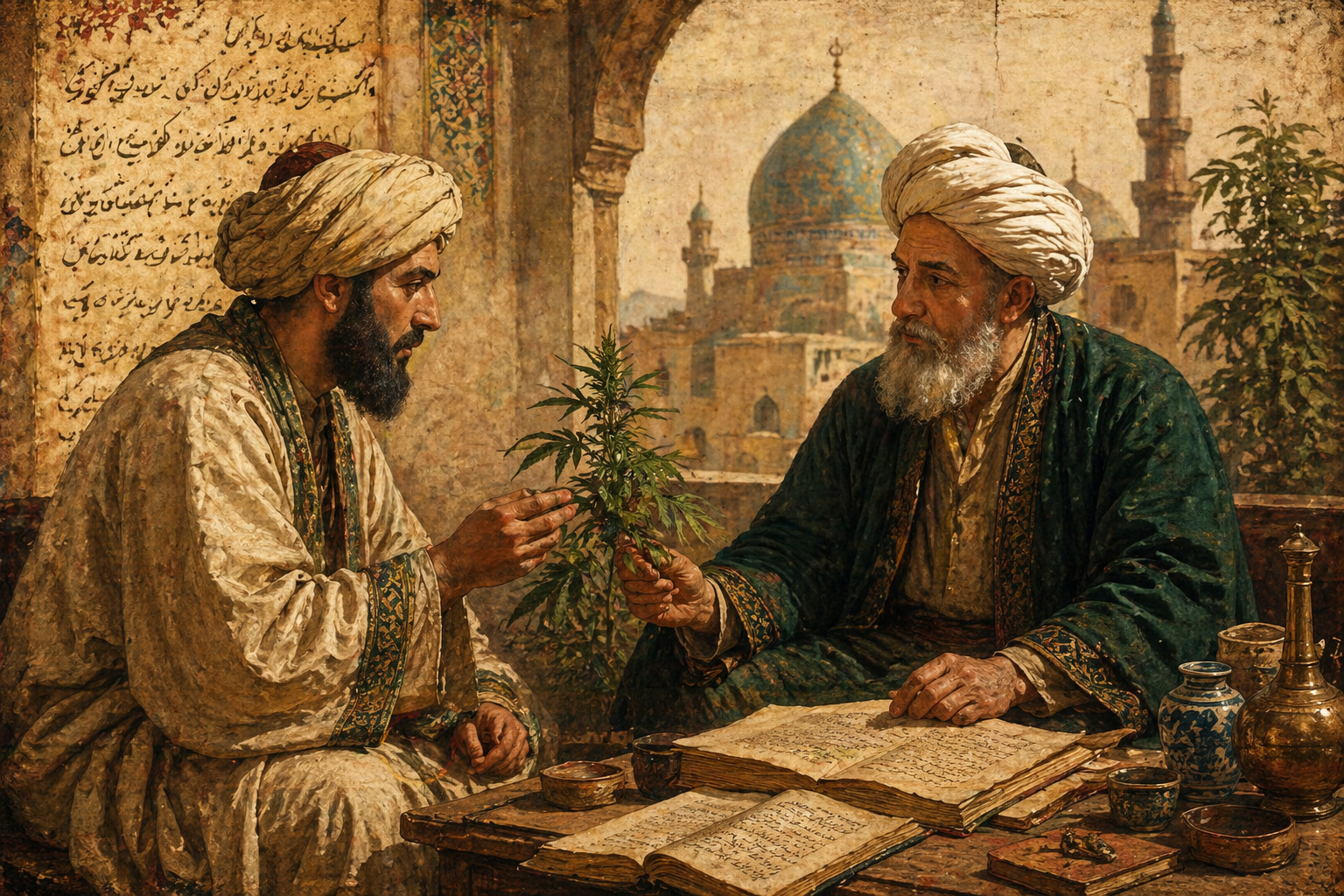
Medical texts from the Islamic world document its use in treating a range of conditions. Rather than framing it as a vice, these sources treated cannabis as a functional substance with specific applications. It was used to manage pain, address digestive issues, and alleviate certain neurological symptoms.
Figures such as Ibn Sina, known in the West as Avicenna, contributed to a broader medical tradition that emphasized observation and practical outcomes. Within that framework, cannabis had a place, even if its non-medical use remained controversial.
This dual identity, questioned in religious contexts but accepted in medical ones, helped sustain its presence across centuries.
Cultural Expression and Literature
Cannabis also appeared in literature and poetry, offering another lens for understanding its role in society.
Writers sometimes used it as a point of comparison with wine, which was both culturally significant and religiously forbidden. In some cases, cannabis was portrayed as the lesser of two evils, or even as a preferable alternative.
These references were not endorsements in a modern sense, but they reflect familiarity and engagement. Cannabis was part of the cultural conversation, not an obscure or marginal phenomenon.
Attempts at Control
Throughout history, there were moments when authorities attempted to restrict or ban cannabis. These efforts were rarely uniform or permanent. They tended to arise in response to specific social or political concerns rather than as part of a consistent religious campaign.
Rulers sought to regulate behavior, maintain order, and reinforce authority. Cannabis, associated with certain social groups and patterns of use, became one of several targets.
Despite these efforts, its use persisted. This continuity suggests that prohibition, where it existed, was only partially effective and often contested in practice.
The Shift to Modern Interpretations
The widespread view of cannabis as haram today reflects a more standardized interpretation of Islamic law. Over time, the principle that all intoxicants are forbidden became more firmly established, reducing the space for earlier debates.
Modern legal systems and global drug policies also played a role. As states adopted stricter regulations, religious interpretations often aligned with these frameworks, reinforcing a unified stance against cannabis.
What had once been a fragmented and context-dependent issue became more clearly defined.
Conclusion
Cannabis in the Islamic world has never followed a simple trajectory. It has been used, questioned, regulated, and reinterpreted across different periods and societies.
Rather than fitting neatly into a category of allowed or forbidden, it occupied a shifting position shaped by competing influences. Religion, medicine, class, and politics all played a role in determining how it was viewed.
Recognizing this complexity does not change modern beliefs, but it does provide a more accurate understanding of the past. The history of cannabis in the Islamic world is not one of certainty, but of ongoing negotiation.