
Cannabis Rescheduling: Progress or Problem? Why the Industry Is Divided

Why the Cannabis Industry Is Nervous About Rescheduling
Part Two of a Three-Part Series – read part one here.
Since reports emerged that the Trump administration may move cannabis from Schedule I to Schedule III, the reaction across the cannabis industry has been anything but uniform.
While some operators see rescheduling as long-overdue progress, others have responded with visible anxiety — particularly across social media, where industry veterans, founders, and executives have begun publicly warning that the move could create new risks rather than relief.
This tension matters because it reveals something important: the debate over rescheduling is no longer just political. It’s structural. And it cuts directly through the business realities of the modern cannabis industry.
A Nervous Industry — and a Loud Conversation
In the days following the initial rescheduling reports, Instagram, LinkedIn, and X were filled with posts dissecting what Schedule III could mean. Some were measured. Others were alarmist. Most shared a common theme: uncertainty.
Much of the concern did not come from outside critics or prohibitionist voices, but from people deeply embedded in cannabis — founders, operators, and long-time advocates who have lived through multiple regulatory shifts before.
That context is important. This isn’t panic from ignorance. It’s anxiety born from experience.
Josh Kesselman’s Warning — and Why It Hit a Nerve
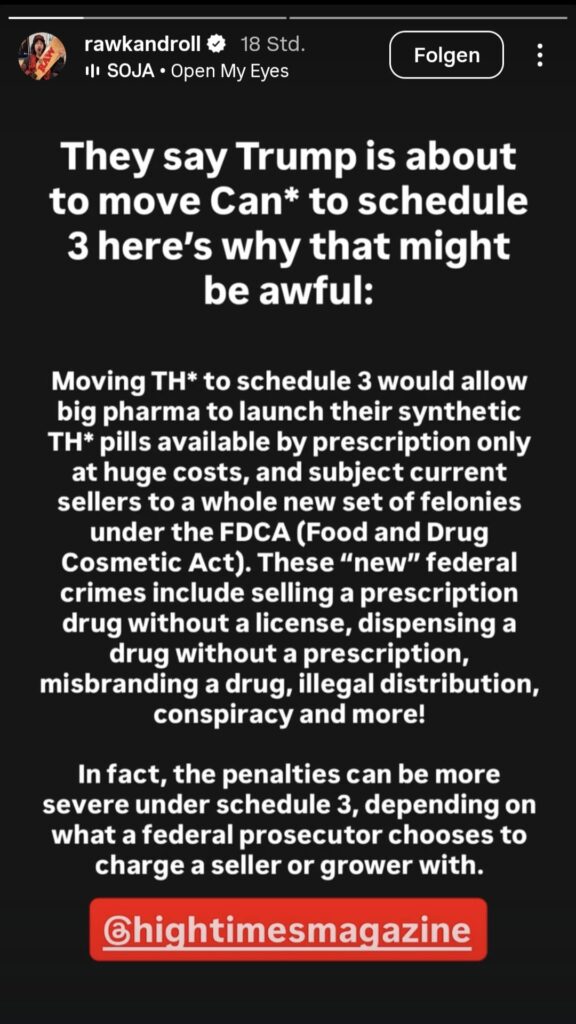
One of the most widely shared reactions came from Josh Kesselman, founder of RAW Rolling Papers and the new owner of High Times Magazine. In an Instagram story that quickly circulated across the industry, Kesselman warned that moving cannabis to Schedule III could lead to unintended consequences — including increased FDA involvement, pharmaceutical-style regulation, and potential legal exposure for parts of the industry.
Given Kesselman’s long history in cannabis culture and commerce, the reaction was unsurprising. His voice carries weight precisely because he has witnessed how regulatory shifts often produce outcomes very different from what policymakers initially promise.
At the same time, several of the worst-case scenarios outlined in the post rely on assumptions that are not yet supported by the current legal framework. Rescheduling alone does not automatically impose prescription-only models, nor does it override state-regulated cannabis markets or instantly criminalize existing operators.
In that sense, Kesselman’s message is best understood not as a prediction, but as a cautionary interpretation of where things could go if federal agencies choose the most aggressive path available to them. That concern is not irrational — but it is not inevitable either.
The distinction matters. Treating potential outcomes as guaranteed risks amplifies fear at a moment when much of the policy process remains unresolved.
The Core Fear Isn’t Rescheduling — It’s Enforcement
Strip away the headlines and Instagram captions, and a clear pattern emerges: the primary fear isn’t that cannabis will be rescheduled. It’s how federal agencies might behave during the transition.
For decades, cannabis has existed in a contradictory legal space. Federally illegal, but state-legal. Criminalized on paper, tolerated in practice. That ambiguity created risk — but it also created breathing room.
Rescheduling threatens to replace ambiguity with structure. And structure brings enforcement.
The agencies most often mentioned in industry concerns are not the DEA, but the IRS and the FDA. Not because they are newly empowered, but because their roles could become more clearly defined.
280E: Relief on Paper, Anxiety in Reality
No issue captures this tension better than Section 280E of the U.S. tax code.
For years, 280E has prevented cannabis businesses from deducting normal operating expenses, forcing many licensed operators to pay effective tax rates that would be unthinkable in any other industry. Schedule III would, in theory, eliminate 280E going forward — a major win.
But that relief comes with a caveat: past tax years don’t disappear.
Some operators worry that as cannabis exits Schedule I, the IRS could become more aggressive in auditing prior years, locking in liabilities before losing leverage. Broader trends amplify this fear: tighter agency budgets, a stronger focus on collections, and a history of strict interpretations of cannabis-related accounting.
To be clear, this concern is not imaginary. Transitional periods often bring heightened scrutiny. But it’s also important to note that aggressive 280E enforcement already exists today. Rescheduling doesn’t create that risk — it merely brings it into sharper focus.
FDA Oversight and the Fear of “Medicalization”
Another recurring concern centers on the FDA.
Schedule III places cannabis more firmly within a medical framework at the federal level. For some, that raises fears of pharmaceutical-style oversight: prescription models, product approvals, labeling requirements, and restrictions that feel incompatible with existing state cannabis systems.
Here again, nuance matters.
Rescheduling alone does not hand control of cannabis markets to the FDA. State-regulated medical and adult-use programs do not vanish overnight. But it does strengthen the FDA’s voice in certain areas — particularly around health claims, product safety, and interstate issues.
For compliant operators, this could mean higher standards. For businesses operating in legal gray zones, it could mean exposure.
The Divide Few Want to Say Out Loud
One uncomfortable reality has become harder to ignore as the rescheduling debate unfolds: not all cannabis businesses are in the same position.
Licensed operators with conservative accounting, documented compliance, and clear regulatory alignment tend to view rescheduling as a net positive — even if the transition is bumpy.
By contrast, businesses built on aggressive interpretations, legal loopholes, or regulatory ambiguity often see clarity as a threat. Chaos, for all its stress, protected certain models. Order will not.
That doesn’t make concern illegitimate — but it does explain why reactions vary so dramatically.
So, Is the Fear Justified?
The honest answer is: partially.
There are legitimate short-term risks associated with enforcement behavior, tax scrutiny, and regulatory adjustments. Ignoring those risks would be naïve.
At the same time, many of the loudest fears assume worst-case scenarios as inevitabilities. They treat rescheduling as a finished policy rather than a process still unfolding, shaped by rulemaking, political pressure, and legal challenge.
What’s missing from much of the online discourse is patience — and perspective.
Looking Ahead
Rescheduling cannabis does not answer every question the industry has been asking for decades. But it forces a reckoning with how the industry has adapted to legal contradictions — and how it will function once some of those contradictions disappear.
In Part Three of this series, we’ll step back from fear and focus on outcomes: who stands to benefit from rescheduling, who may struggle, and how this shift could reshape the cannabis industry in the years ahead.
Because the real story isn’t whether Schedule III is good or bad — it’s who it changes the game for.







My question is would this eliminate marijuana from being tested on drug screening tests for future employment screening?
No. Even if marijuana is officially moved from Schedule I to Schedule III, it will still be detectable on drug screening tests and can still be used by employers in hiring decisions.
Rescheduling mainly affects federal drug policy, not workplace testing rules.
A few key points to understand:
Drug tests don’t care about scheduling. Standard urine, saliva, and hair tests screen for THC metabolites, regardless of whether cannabis is Schedule I, III, or fully legal at the state level.
Employers set their own policies. Most private employers can still test for marijuana and choose not to hire candidates who test positive — unless restricted by state or local law.
Federal workplaces are unchanged. Federal employees, contractors, DOT-regulated jobs (truck drivers, pilots, etc.), and safety-sensitive positions will continue testing for THC.
State laws matter more than rescheduling. Some states already limit or ban pre-employment cannabis testing (except for safety roles). Those protections come from state labor laws, not federal scheduling changes.