Can You Own a Gun If You Use Cannabis? The Supreme Court Is About to Decide
Key Takeaways
- Federal law still prohibits cannabis users from owning firearms
- State legalization does not override federal restrictions
- The Supreme Court is reviewing whether this violates the Second Amendment
- A decision is expected in the coming months
- The outcome could impact millions of cannabis users
In much of the United States, you can legally walk into a dispensary, purchase cannabis, and use it without fear of state-level prosecution. In some cases, you can even do so for medical reasons with a doctor’s recommendation.
But under federal law, that same person may be committing a serious crime if they also own a firearm.
This contradiction is now at the center of a major legal battle heading toward a decision by the U.S. Supreme Court — one that could redefine how cannabis users are treated under federal law and the Constitution.
A Law That Hasn’t Caught Up With Reality
The issue stems from a federal statute that prohibits “unlawful users of controlled substances” from possessing firearms. Because cannabis remains classified as a Schedule I drug under federal law, anyone who uses it — regardless of state legality — falls into that category.
In practice, this creates a situation where millions of otherwise law-abiding citizens are technically violating federal gun laws simply by using cannabis.
The conflict is no longer theoretical. As legalization spreads across states, the gap between state and federal law has become increasingly difficult to ignore. What was once a niche legal issue has turned into a nationwide contradiction.
The Constitutional Question
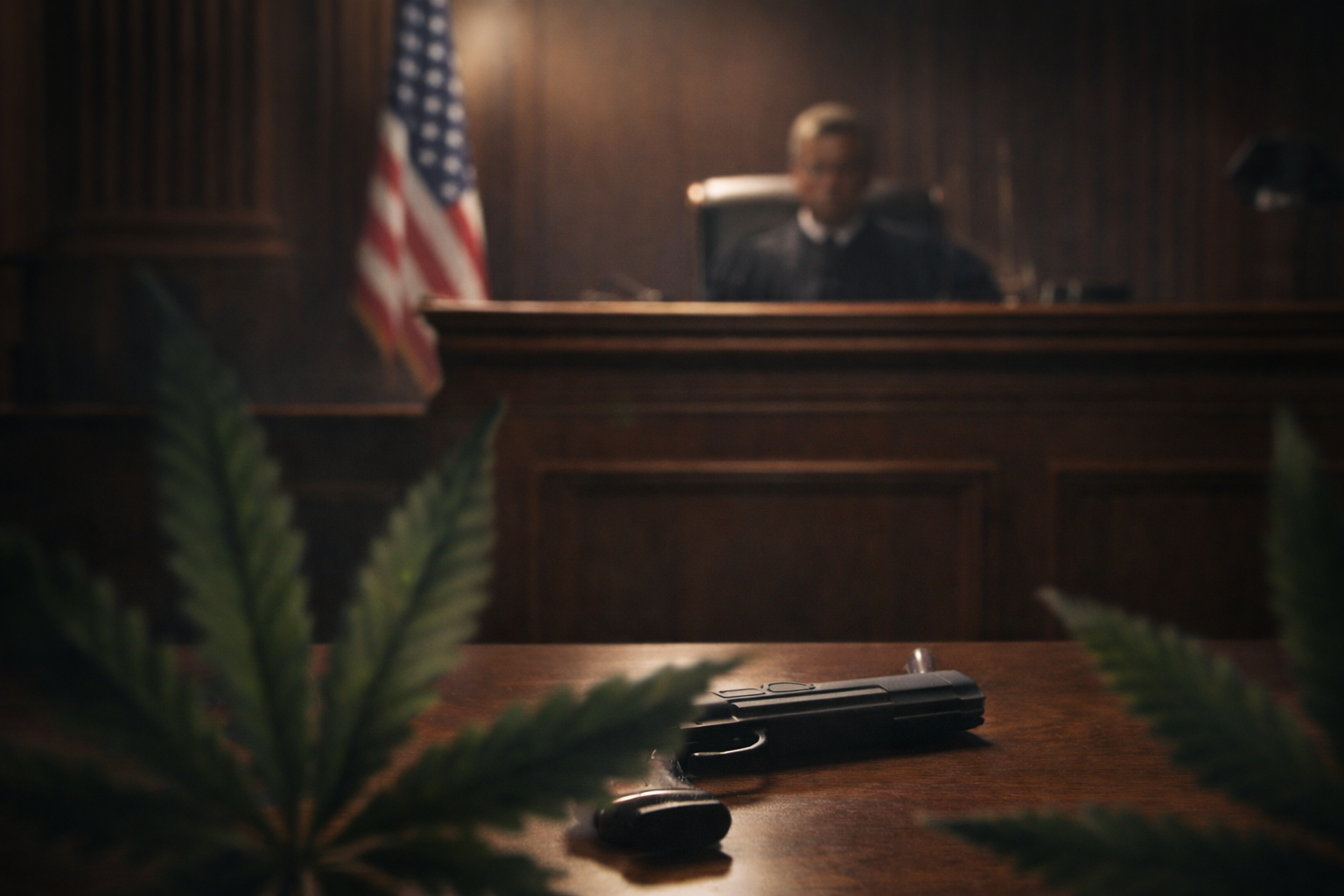
The case now before the Supreme Court challenges the constitutionality of this restriction under the Second Amendment, which protects the right to bear arms.
At the heart of the argument is a broader legal shift that has taken place in recent years. Courts have increasingly evaluated gun laws based on historical precedent — asking whether similar restrictions existed when the Constitution was written.
Critics of the federal cannabis firearm ban argue that such historical analogues are weak or nonexistent. They claim that disarming individuals solely based on substance use — particularly one that is legal at the state level — stretches the limits of constitutional authority.
Supporters of the law, however, argue that the restriction is rooted in public safety. The federal government maintains that individuals using controlled substances may pose an elevated risk, justifying limitations on firearm possession.
A Case That Reflects a Larger Conflict
Beyond the legal arguments, the case highlights a deeper structural issue within U.S. drug policy.
Cannabis exists in a gray zone. It is simultaneously a legal consumer product in many states and an illegal substance under federal law. This duality creates ripple effects across banking, employment, taxation, and now, constitutional rights.
For cannabis users, the consequences are not always obvious. Many are unaware that purchasing a firearm while using cannabis could expose them to federal charges. Others may assume that state legality provides protection across the board.
It does not.
This disconnect between perception and legal reality is one of the most significant risks facing consumers today.
Why This Decision Matters
The Supreme Court’s ruling will not just affect a narrow group of individuals. It has the potential to impact millions of Americans who use cannabis in states where it is legal.
If the Court upholds the federal restriction, the current contradiction remains in place. Cannabis users would continue to face a choice between exercising their right to use a legal substance under state law and their right to own a firearm under the Constitution.
If the Court strikes down the restriction, it could mark a significant shift in how cannabis is treated within federal legal frameworks — potentially opening the door to broader reforms.
Either outcome will carry implications far beyond gun ownership.
A System in Transition
This case is part of a larger pattern. As cannabis legalization expands, federal law is increasingly being tested in areas it was never designed to accommodate.
Courts are being asked to resolve conflicts that lawmakers have yet to address. In many ways, the judiciary is now acting as the pressure point where outdated policy meets modern reality.
For consumers, this means one thing: uncertainty.
Until federal law evolves or the courts intervene decisively, contradictions like this will continue to surface — often in areas with serious legal consequences.
What Happens Next
The Supreme Court has already heard arguments in the case, meaning a decision is expected in the coming months, likely between late spring and early summer.
Until then, the legal landscape remains unchanged.
Cannabis users are still classified as unlawful users under federal law. Firearm possession, in that context, remains legally risky — regardless of what state law permits.
For now, the safest approach is awareness.
While cannabis legalization has moved forward rapidly, the legal system surrounding it is still catching up.
Series Note
This article is part of International High Life’s ongoing coverage of cannabis policy, law, and real-world implications — bridging the gap between legalization and the realities consumers face today.