Cannabis Strains Explained: What Indica Sativa and Hybrid Really Mean
Walk into any dispensary or browse an online menu, and you’ll immediately see three familiar labels: indica, sativa, and hybrid. For years, these categories have shaped how people choose their cannabis, often boiled down to a simple idea:
Indica relaxes you
Sativa energizes you
Hybrids sit somewhere in between
It sounds straightforward, but modern cannabis is far more complex than that. In reality, these labels only tell part of the story—and sometimes, they can even be misleading.
This guide breaks down what indica, sativa, and hybrid actually mean today, how accurate these labels really are, and what you should focus on instead when choosing a strain.
1. What Are Cannabis Strains?

A cannabis strain refers to a specific variety of the plant, bred for certain characteristics such as:
- Cannabinoid content like THC or CBD
- Aroma and flavor (terpenes)
- Growth structure and yield
- Effects and user experience
Over decades of selective breeding, growers have created thousands of strains—many of which are now hybrids.
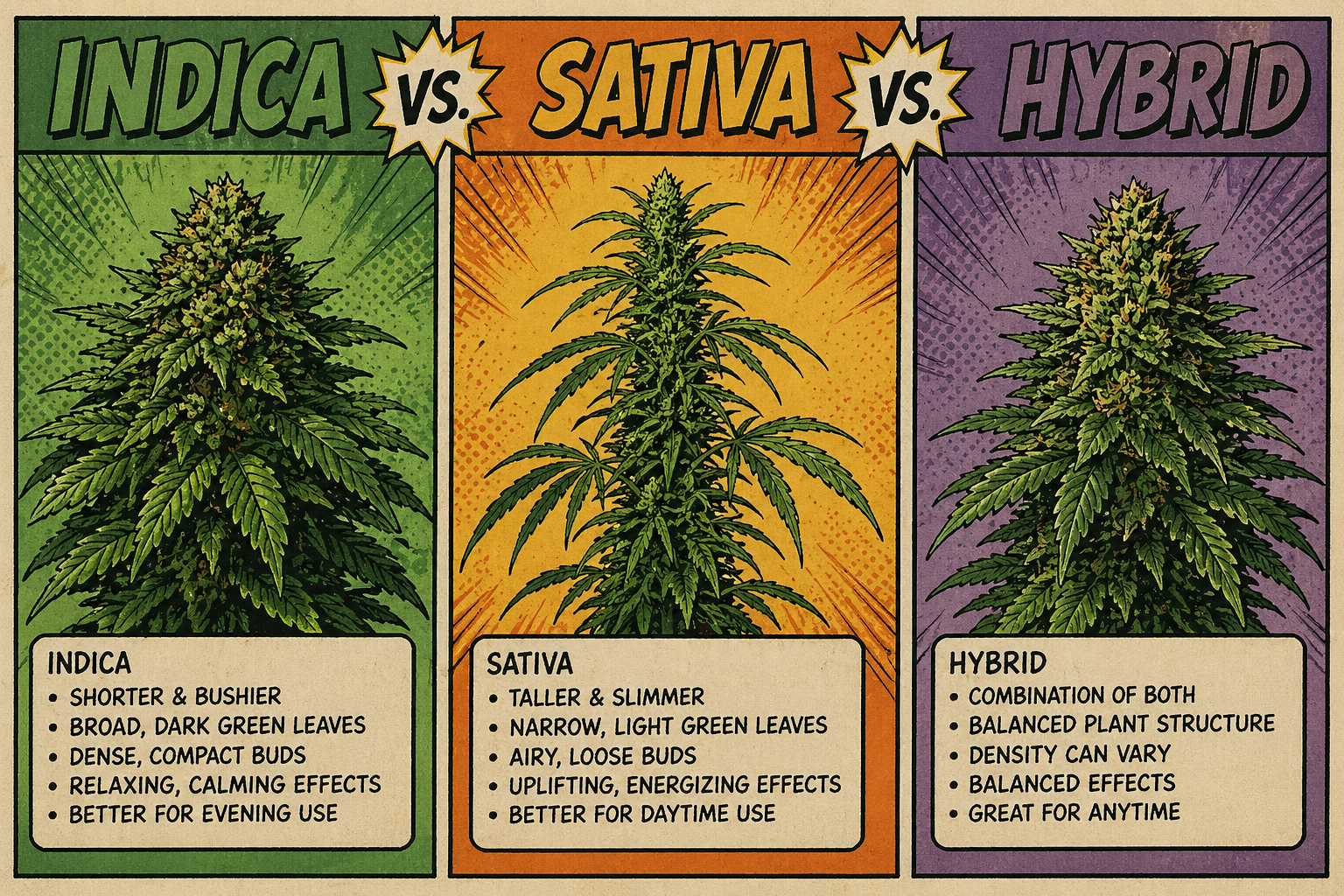
Indica: What It Traditionally Means
Historically, indica strains were associated with plants originating from regions like Afghanistan and India. These plants developed certain traits to survive harsher climates.
Typical characteristics:
- Short, bushy plants
- Wide, dark green leaves
- Dense, compact buds
- Faster flowering times
Commonly associated effects:
- Physical relaxation
- Sedation
- “Body high”
- Better suited for evening use
This is where the classic idea of “indica equals couchlock” comes from.
Sativa: What It Traditionally Means
Sativa strains were originally associated with plants from equatorial regions such as Southeast Asia and Central America.
Typical characteristics:
- Tall, slender plants
- Narrow leaves
- Airy, elongated buds
- Longer flowering times
Commonly associated effects:
- Uplifting and energizing
- Mental stimulation
- Creativity and focus
This led to the idea of “sativa equals daytime weed.”
Hybrid: The Modern Reality
Here’s the key point: almost all cannabis today is hybrid.
Over the years, pure indica or sativa strains have become extremely rare. Most strains you see today combine genetics from both sides.
Hybrids are often labeled as:
- Indica-dominant
- Sativa-dominant
- Balanced
But even these labels are broad generalizations.
The Problem With Indica vs Sativa
The biggest misconception in cannabis is that indica and sativa reliably predict effects.
They don’t.
Two strains labeled “indica” can produce completely different experiences. The same goes for sativa.
Why?
Because effects are driven by chemical composition rather than plant shape
What Actually Determines the Effects
To understand how a strain will feel, you need to look beyond labels and focus on:
1. Cannabinoids
The most important compounds in cannabis include:
- THC, which drives the psychoactive high
- CBD, which can reduce anxiety and balance THC
- Minor cannabinoids like CBG or CBN
A high-THC indica may feel very different from a balanced THC CBD hybrid.
2. Terpenes
Terpenes are aromatic compounds that heavily influence effects.
For example:
- Myrcene is linked to relaxation and sedation
- Limonene is associated with mood elevation
- Pinene can promote alertness
This is why two strains with similar THC levels can feel completely different.
3. Your Body Chemistry
Effects also depend on the individual:
- Tolerance level
- Mood and environment
- Method of consumption
This is often referred to as “set and setting.”
Is the Indica vs Sativa Categorization Still Relevant in 2026
Short answer: not really, but it hasn’t disappeared for a reason.
The traditional indica vs sativa classification has lost most of its practical relevance for consumers. Decades of crossbreeding have blurred the genetic lines to the point where almost all modern cannabis is hybrid in one way or another.
What used to be a meaningful distinction based on plant origin and structure is now largely a legacy system. That’s something the industry still uses because it’s familiar, not because it’s scientifically accurate in predicting effects.
That said, the categorization hasn’t become completely useless.
It still serves a few specific purposes:
- Cultivation context
Growers still use indica and sativa traits to understand plant structure, flowering time, and yield potential. - General orientation for beginners
For new consumers, the labels can act as a rough entry point into cannabis, even if they oversimplify reality. - Cultural and marketing shorthand
The terms remain deeply embedded in cannabis culture and retail environments, making them hard to replace overnight.
However, for anyone trying to predict how a strain will actually feel, indica vs sativa is no longer a reliable framework.
In 2026, relying on these labels alone is like choosing wine based only on the color of the bottle—it gives you a vague idea, but it tells you almost nothing about the actual experience.
If you want consistency and control, cannabinoid levels, terpene profiles, and product quality are what really matter.
How to Choose the Right Strain Instead
A better approach is to move away from labels and toward measurable, experience-driven factors. Think of choosing cannabis more like choosing wine or coffee—flavor, strength, and personal preference matter far more than the category name.
1. Start With Cannabinoid Levels
Before anything else, check THC and CBD percentages.
- High THC (15–30%)
Strong psychoactive effects can be overwhelming for beginners. Often linked to intensity rather than a specific “type” of high. - Balanced THC CBD strains
More controlled, smoother experience. CBD can reduce anxiety and make the high feel more functional. - Low THC or CBD dominant
Ideal for users who want relaxation without a strong high.
A common mistake is assuming all indicas are “strong” or all sativas are “light.” In reality, potency varies massively regardless of the label.
2. Learn Basic Terpene Profiles
If you want to actually predict how a strain feels, terpenes are your best indicator.
Instead of memorizing dozens, focus on a few key ones:
- Myrcene-dominant strains
Often associated with heavier, more relaxing effects. Common in strains people describe as “indica-like.” - Limonene-dominant strains
Typically, more uplifting and mood-enhancing. - Pinene-dominant strains
Linked to clarity and alertness.
This is where things get interesting: a “sativa” high in myrcene can feel more sedating than an “indica” rich in limonene.
That’s why experienced consumers increasingly ignore indica vs sativa and look directly at terpene content.
3. Consider Your Intent, Not Just the Product
Before choosing a strain, define what you actually want from the experience.
Ask yourself:
- Do I want to relax physically?
- Do I want to stay productive or social?
- Am I using it for sleep, stress, or creativity?
Once you’re clear on the goal, it becomes much easier to filter strains by composition rather than by marketing labels.
For example:
- Evening use → look for higher myrcene, moderate THC
- Daytime use → lower THC, uplifting terpene profile
- Social settings → balanced strains with limonene or pinene
This intent-first approach is far more reliable than picking something just because it’s labeled indica or sativa.
4. Pay Attention to Consumption Method
The same strain can feel completely different depending on how you consume it.
- Smoking or vaping
Fast onset, easier to control dosage - Edibles
Slower onset, stronger, and longer-lasting effects due to liver metabolism - Concentrates
Much higher potency, not ideal for beginners
This is critical: many “bad strain experiences” are actually dosage or method issues, not the strain itself.
5. Track Your Experience
One of the most underrated strategies is simply keeping track of what works for you.
You don’t need anything complicated. Just note:
- Strain name
- THC and CBD levels
- Terpene profile, if available
- How it made you feel
After a few sessions, patterns become obvious. You’ll start recognizing what your body responds to—far more valuable than any label.
Why Strain Names Can Be Misleading
Another important factor is branding.
Names like “OG Kush,” “Gelato,” or “Blue Dream” sound familiar, but they are not standardized as pharmaceutical products are. The same strain name can vary significantly depending on the grower, genetics, and cultivation process.
This means:
- Two “identical” strains from different sources can feel different
- Quality and cultivation methods matter just as much as genetics
- Lab testing is often more reliable than the name itself
In other words, don’t rely solely on strain names. Use them as a reference point, not a guarantee.
Conclusion
Indica, sativa, and hybrid are useful as a starting framework, especially for beginners trying to navigate cannabis for the first time.
But modern cannabis has evolved far beyond these categories.
Today, the real differentiators are:
- Chemical composition
- Terpene profile
- Product quality
- Personal response
Understanding this shift is what separates casual users from informed consumers.
Once you move past the labels, you gain far more control over your experience—and that’s ultimately what cannabis is about.